
Affiliate disclosure: This post contains affiliate links. If you choose to purchase through them, I may earn a small commission — at no extra cost to you. I only recommend products I genuinely use or that fit a slow, seasonal way of living.
January 6th — known as Epiphany or Three Kings’ Day — has always marked a quiet turning point in Central Europe.
Not a loud ending.
Not a sudden return to everyday life.
But a slow transition, where Christmas gently steps back and winter fully settles in.
Traditionally, this was the day when Christmas trees were removed, decorations packed away, and homes returned to their winter rhythm. Yet, like many Central European traditions, this moment was never about strict rules — it was about sensing when a season had run its course.
When Christmas Trees Came Down — But Not Everything Disappeared
Growing up, January 6th was the day.
The Christmas tree came down. Ornaments were wrapped carefully in newspaper. The room suddenly felt larger — and a little quieter.
Even today, we still remove the tree around this time.
But we never remove everything.
We keep the Christmas lights.
January is dark here. Long, heavy, and slow. Those warm lights feel less like decoration and more like companionship. They stay with us through January evenings, softening the darkness and reminding us that winter is meant to be lived gently.
This isn’t about holding on to Christmas.
It’s about honoring winter as it truly is.
Habarka: A Kitchen Tool Made from the Christmas Tree
One of the most beautiful traditions tied to this day is habarka.
Each year, after Christmas, a new habarka was made from the top of the Christmas tree. The young, flexible tree tip was cleaned of bark and shaped by hand into a simple wooden whisk.
This freshly made habarka was then used throughout the year for mixing pancake batter or stirring simple doughs.
Nothing was wasted.
The Christmas tree didn’t simply disappear — it transformed.
Each year brought a new habarka, slightly different in shape and feel, reminding us that tools don’t need to last forever to be meaningful. They just need to serve their purpose well.

In the East of Slovakia, Christmas Begins on January 6th
What makes January 6th especially fascinating is how differently it is lived across Central Europe.
In the very east of Slovakia, and in some Eastern Christian traditions, Christmas doesn’t end on January 6th — it begins.
While many households elsewhere are closing the season, some churches are only just starting to celebrate Christmas. The calendar shifts, but the meaning remains the same: light entering darkness.
It’s a powerful reminder that traditions are regional, layered, and alive — not fixed dates on a universal calendar.
C + M + B: Blessing the Home on Three Kings’ Day
January 6th is also marked by the house blessing tradition.
Priests — or groups symbolically representing the Three Kings — would go from house to house:
- blessing homes with holy water
- offering prayers for health and protection
- marking door frames with C + M + B and the year
The letters stand for Caspar, Melchior, and Balthazar, and are also understood as a Latin blessing:
Christus mansionem benedicat — May Christ bless this home.
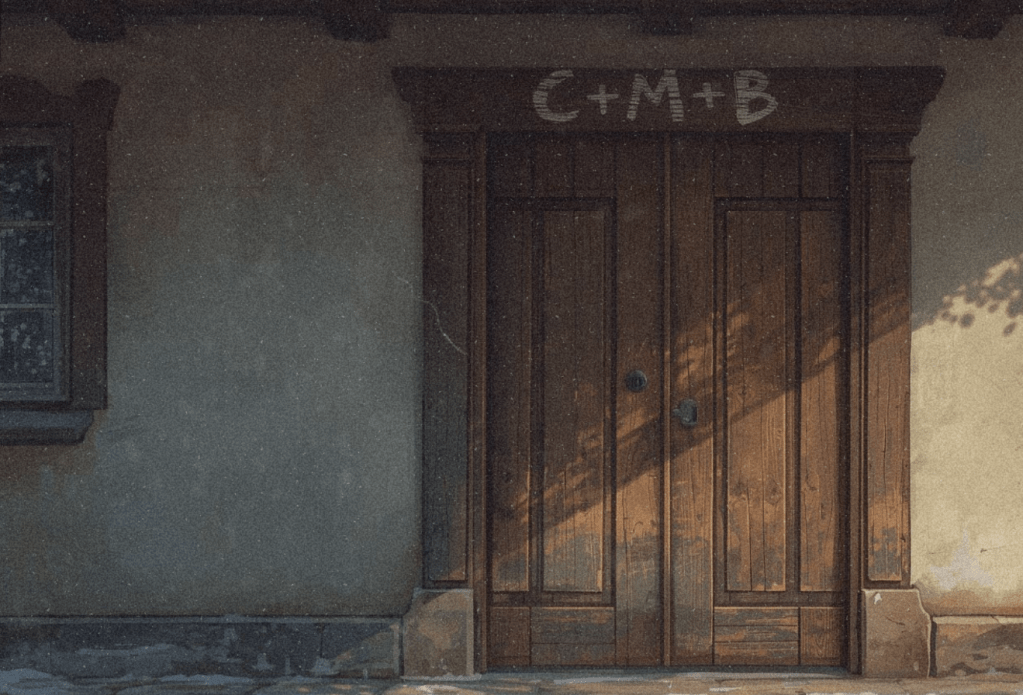
Often, money was collected during these visits and donated to charity, extending the ritual beyond the household and into the wider community.
Even for those who are not religious, this moment carries a sense of closure — a gentle wish spoken at the threshold before the year truly begins.
Traditional beeswax candles often used for Epiphany blessings are available here → https://amzn.to/3L63e5N.
What Comes After Christmas in Central Europe?
After Advent and Christmas, January doesn’t demand productivity.
Traditionally, this was a resting season. The soil was frozen, the fields quiet — and hands turned to slower work indoors. A little knitting, a bit of crocheting, woven gently into winter days. Nothing rushed, nothing urgent. Just enough movement to keep warmth, rhythm, and patience alive.
What comes next is not urgency, but winter itself.
The Sledging Season Before Fašiangy
January belongs to sledging.
Before fašiangy (Carnival season) begins, winter is about movement and play: snow-covered hills, red cheeks, frozen fingers, and coming home tired in the best possible way.
Sledging doesn’t require planning or perfection.
Just snow, gravity, and presence.
It’s the perfect counterbalance to winter stillness — joyful, physical, and deeply seasonal.
A Gentle Transition, Not a Hard Stop
For me, January 6th is not about closing Christmas “properly.”
It’s about transition.
Letting go of what feels complete.
Keeping what still brings warmth.
Allowing the season to change without forcing it.
Central European winters were never built for speed. They were built for endurance, quiet routines, and small lights glowing in long darkness.
Christmas fades.
Winter deepens.
And slowly, life prepares for what comes next.
That, too, is slow living.

Pridaj komentár